管理人オススメコンテンツはこちら
「社会保険の概要徹底解説|国が守る、あなたの生活安心プラン」
〜前回のつづき〜
●健康も、年金も、失業も~“社会保険”は全部まとめて国がやってる~

社会保険とは
どういう制度かというと
国民の生活を守るために
病気や老後のリスクに備える
社会保障という事で
国がやってる
保険みたいなものですね。
社会保険の指す意味って
狭義と広義があって
社会保険と言っても
健康保険の事を話ししてたりとか
年金の部分を話してたりとか
結構色々なんですよね。
だからもう一度
全体図を見たいんですけど
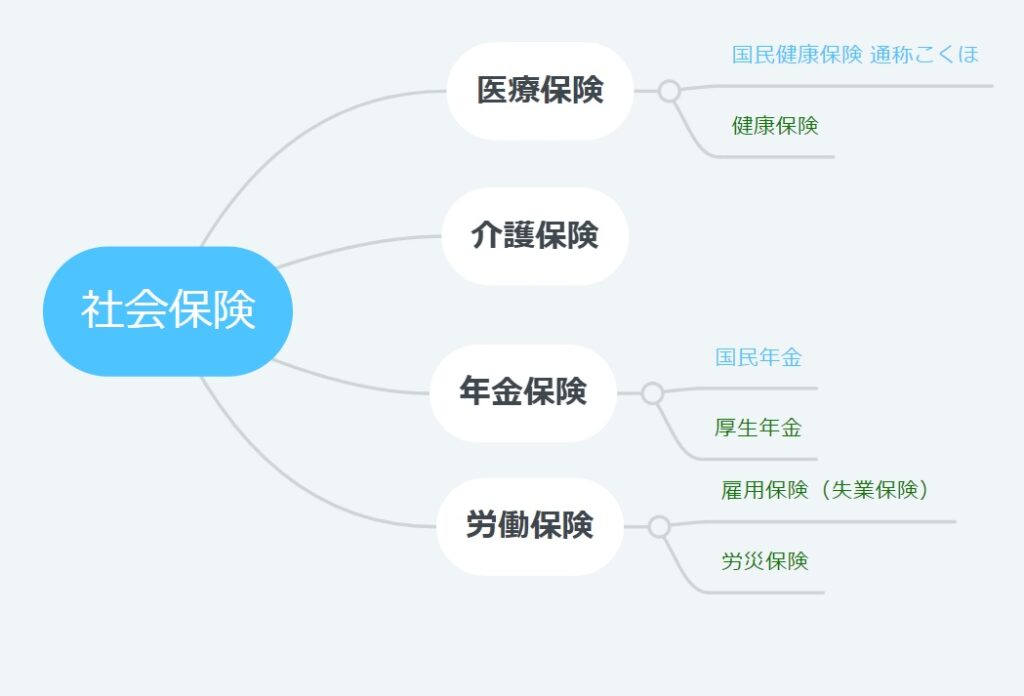
大カテゴリーとして
社会保険があり
中カテゴリーの中で
・医療保険
・介護保険
・年金保険
・労働保険
が有ります。
中でも医療保険の中に
・国民健康保険(通称こくほ)
・健康保険
が有ります。
名前が似てるんですけど
両方別物で
健康保険は会社員が入る方です。
国民健康保険というのは
自営業者が入る。
どっちかに入るんですよね。
また年金には
・国民年金
・厚生年金
が有ります。
それから労働保険には
・雇用保険
いわゆる
『失業保険』『失業給付』
と呼ばれてるものですよね。
・会社を辞めた時
・会社が潰れてしまった時
しばらくもらえる給付金です。
それから労働保険。
通勤中に怪我した時とか
一部手当が出たりするんですけど
水色の部分が
個人事業主が入る保険ですね。
(国民年金・国民健康保険)
緑色の方が
会社員が加入する保険ですね。
(健康保険・厚生年金など)
ここをまず
覚えておいてほしい。
金額がそれぞれ
いくらかかるのか?
という事なんですけど
・健康保険
・厚生年金
どうやって決まるのか?
4〜6月の給与(標準報酬月額)で
決まるんでしたよね?
国民年金なんかは
一律定額なんですけどね。
これは
今までのお話しの中でも
出てきてるので見て下さい。
〜〜〜つづく〜〜〜
Special Thanks college president Ryo.

●おまけ
≪≪perplexityちゃんによる文章まとめ≫≫
社会保険は、国民の生活を病気や老後、失業などのリスクから守るために国が運営する保険制度です。
大きく「医療保険」「介護保険」「年金保険」「労働保険」の4つに分かれます。
医療保険には、自営業者が加入する国民健康保険と会社員が加入する健康保険があり、年金保険は国民年金と厚生年金に分かれます。
労働保険には失業時に給付が受けられる雇用保険や、通勤や仕事中の怪我に対応する労災保険があります。
個人事業主は主に国民健康保険と国民年金に加入し、会社員は健康保険や厚生年金、労働保険に加入します。
保険料は健康保険や厚生年金は4~6月の給与を基に決まり、国民年金は一律の定額です。
社会保険は国がまとめて管理し、働き方に応じて適切な保険に加入する仕組みとなっています。
[1] https://www.mhlw.go.jp/tekiyoukakudai/dai1hihokensha/
[2] https://www.mhlw.go.jp/tekiyoukakudai/
[3] https://www.nenkin.go.jp/service/riyoushabetsu/jigyonushi/index.html
[4] https://www.nenkin.go.jp
[5] https://www.obc.co.jp/360/list/post211
[6] https://www.ssk.or.jp
[7] https://www.kyoukaikenpo.or.jp
[8] https://www.zensharen.jp
[9] https://www.gov-online.go.jp/article/202408/entry-6338.html
[10] https://www.fsa.go.jp/ordinary/insurance-portal.html
≪≪Chat-GPTくんによる英訳≫≫
~Continuation from the Last Time~
【Health, pension, unemployment—all managed together by the government as “Social Insurance”】
—
What is Social Insurance?
To explain what kind of system it is:
It’s a form of social security designed to protect people’s lives by preparing for risks such as illness and old age.
In essence, it’s like government-run insurance.
—
The term “social insurance”
has both a narrow and broad definition.
Even when people say “social insurance,”
they might be referring only to health insurance,
or sometimes just the pension portion.
So, it actually covers quite a lot.
That’s why it’s good to take another look
at the overall structure.
—
Broad Categories:
At the top level, there’s Social Insurance.
Under that, we have the mid-level categories:
Medical Insurance
Nursing Care Insurance
Pension Insurance
Labor Insurance
—
Within Medical Insurance, there are:
National Health Insurance (commonly known as Kokuho)
Employee Health Insurance
The names are similar,
but they are completely different systems.
Employee Health Insurance is for company employees.
National Health Insurance is for the self-employed.
People enroll in one or the other.
—
As for Pensions, there are:
National Pension
Employees’ Pension (Welfare Pension)
—
Within Labor Insurance, we have:
Employment Insurance
This is commonly known as:
> “Unemployment Insurance” or “Unemployment Benefits.”
It’s the benefit you receive if:
You quit your job
Or your company goes bankrupt
It’s a temporary financial support.
—
Also under Labor Insurance,
if you’re injured during commuting,
you may receive certain allowances.
—
The blue sections indicate insurance that the self-employed join.
(e.g. National Pension, National Health Insurance)
The green sections are for company employees.
(e.g. Employee Health Insurance, Welfare Pension, etc.)
—
This is something you should remember first.
—
So, how much does it all cost?
When it comes to:
Employee Health Insurance
Welfare Pension
How are the costs determined?
It’s based on your monthly salary from April to June
(called the Standard Monthly Remuneration).
—
In contrast, National Pension has a fixed monthly rate for everyone.
This has already come up in previous explanations,
so feel free to refer back to those.
Special Thanks OpenAI and Perplexity AI, Inc