
管理人オススメコンテンツはこちら
「黄色信号ですね|高給取りほど老後に絶望する理由とは!?」
\NISAやるなら/
●前回のおさらい
FP協会の調査では、多くの人が自分の年金額を把握しておらず、老後資金も曖昧なまま人生設計をしている実態が明らかになっています。
平均的な年金は、国民年金のみで月約5.6万円、厚生年金で月約14.5万円、夫婦世帯でも月20〜22万円程度です。一方、生涯賃金4億円・平均年収1,000万円のエリート会社員でも、年金は月約23万円にとどまります。
高収入でも公的年金だけでは十分とは言えず、早い段階で現実的な金額を把握し、老後に向けた備えを考えることが重要です。
●エリートサラリーマンの年金額はいくら?(つづき)
まずはあらためて
年金受給額を比較してみましょう。
・平均的なサラリーマン:年間約170万円
・エリートサラリーマン:年間280万円
一見すると
大きな差があるように見えますが
注目すべきはその差の大きさです。
現役時代の年収は
エリートサラリーマンの方が
平均的な会社員の2倍以上あるケースも
珍しくありません。
しかし
年金受給額の差は
約1.6倍程度にとどまります。
ここが非常に重要なポイントです。
ニュースや新聞で
平均的な年金受給額を見たとき
「俺は普通の人の2倍の給料が有るから
年金受給額も2倍くらい有るだろう!」
と考えている人がいるとしたら
それは大きな誤解かもしれません。
・社会保険労務士
・ファイナンシャルプランナー
の方々からも
よくこんな声を聞きます。
「大企業に勤めている会社員の大半が
自分の年金額を知ると
その少なさに驚愕するんですよ。」
実際に年間300万円を超える
公的年金を受け取れる人は
ごく一部です。
おそらく
上場企業の役員クラスまで
昇り詰めたような人たちでしょう。
そのため
「高収入だから老後のための貯蓄は必要ない」
なんて考えてる人がいたら
これは黄色信号ですね。
高収入の人ほど
現役時代の生活水準が
高くなりがちなため
退職後に必要となる生活費も
高くなる傾向があります。
結果として
老後の資金不足に陥るリスクは
決して低くありません。
「企業年金があるから安心」は本当か?
ここでよく聞くのが
「公的年金が少ないのは知っているけど
ウチは企業年金が手厚いから大丈夫だよ!」
という声です。
確かに企業年金は
老後資金を支える大きな柱の一つですが
過信は禁物です。
では
企業年金に潜む3つの落とし穴について
見てみましょう。
●企業年金の3つの落とし穴
企業年金とは?
年金制度は一般的に
『3階建て』と表現されます。
.webp)
(出典:リベラルアーツ大学)
1階:国民年金
すべての国民が加入する基礎年金です。
自営業者も会社員も
公務員も加入しています。
2階:厚生年金
会社員や公務員が加入する年金です。
3階:企業年金
主に大企業などが
福利厚生として導入している制度です。
勤務先によっては
この3階部分まで
備わっている人もいます。
そのため
「企業年金があるから老後は絶対安心」
と考える人もいますが
実際にはそう単純ではありません。
落とし穴(1)退職金総額が減り続けている
落とし穴(2)終身年金ではない
落とし穴(3)減額があり得る
この3つの落とし穴があります。
順番にお話しします。
落とし穴(1)退職金総額が減り続けている
相談者の方は
「退職金が3千万円もらえそう」
と言ってたんですけど
本当にそのままいくかどうか
わからないんですよ。
実際に退職金の平均額は
長期的に減少しています。
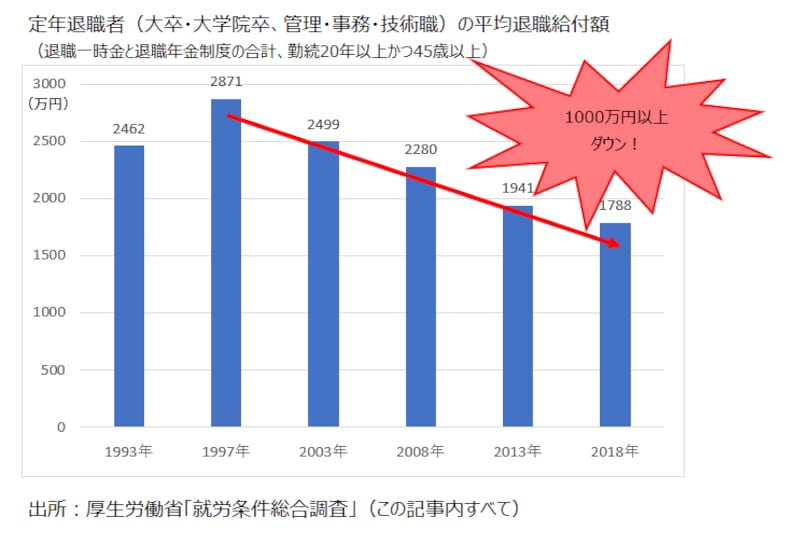
(出典:https://allabout.co.jp/gm/gc/481437/)
・1997年:2,871万円
・2018年:1,778万円
わずか20年余りで
約1,000万円も減少しているのです。
背景には
・年功序列の崩壊
・終身雇用制度の変化
があります。
かつての日本企業は
社員の老後まで面倒を見る
文化がありました。
しかし現在は
企業側にもそこまでの
余裕がなくなっています。
この流れは
今後も大きく変わらないでしょう。
つまり退職金がある前提で
人生設計を立てること自体が
リスクになりつつあるということです。
退職金については
↑こちらでお話ししてます。
ぜひあわせて読んでみてください。
〜〜〜つづく〜〜〜
Special Thanks college president Ryo.
▼無料で口座を作る
●おまけ
≪≪perplexityちゃんによる文章まとめ≫≫
エリートサラリーマンと平均的な会社員では、現役時代の年収に大きな差があるものの、年金受給額の差は約1.6倍にとどまり、比例して増えるわけではありません。平均は年間約170万円、エリートでも約280万円程度で、300万円を超える人はごく一部です。
そのため「高収入だから老後も安心」という考えは危険です。さらに企業年金も万能ではなく、退職金の減少、終身でないケース、減額リスクといった課題があります。実際、退職金は過去20年で約1000万円減少しており、制度への過信は禁物です。
高収入ほど生活水準も高くなりやすく、老後資金不足に陥る可能性もあるため、公的・企業年金に頼らず、自助努力による資産形成が重要です。
Citations:
[1]https://www.shiruporuto.jp/public/document/container/choiyomi/choiyomi025.html
[2]https://www.smbc.co.jp/kojin/money-viva/okane-irowake/0004/
[3]https://gentosha-go.com/articles/-/45227
[4]https://note.com/subsidyjapan/n/n90437f61f01a
[5]https://www.moneypro.jp/columns/asset-management/2481/
≪≪Chat-GPTくんによる英訳≫≫
【A Quick Recap】
According to a survey conducted by the Japan Association of Financial Planners, many people do not know how much pension they will receive and are making life plans without a clear understanding of their retirement finances.
The average public pension is approximately ¥56,000 per month for those receiving only the National Pension and around ¥145,000 per month for those receiving Employees’ Pension benefits. Even for a married couple, total pension income is often only ¥200,000–¥220,000 per month.
On the other hand, even an elite corporate employee with lifetime earnings of ¥400 million and an average annual salary of ¥10 million can expect a public pension of only about ¥230,000 per month.
In other words, even a high income does not necessarily guarantee a comfortable retirement through public pensions alone. That is why it is important to understand the reality of your future pension benefits and start preparing for retirement as early as possible.
【How Much Pension Does an Elite Salaryman Receive? (Continued)】
Let’s compare pension benefits once again.
- Average office worker: approximately ¥1.7 million per year
- Elite corporate employee: approximately ¥2.8 million per year
At first glance, this may seem like a significant difference.
However, what deserves attention is the size of that gap.
During their working years, elite employees often earn more than twice the salary of an average worker.
Yet the difference in pension benefits is only about 1.6 times.
This is a very important point.
When people see average pension figures reported in the news, some may think:
“I earn twice as much as the average person, so my pension should be about twice as high as well.”
If that’s what they believe, they may be in for a surprise.
Both labor and social security attorneys and financial planners frequently say:
“Many employees at large corporations are shocked when they discover how little pension income they will actually receive.”
In reality, only a small percentage of retirees receive more than ¥3 million per year in public pension benefits.
These individuals are likely those who climbed all the way to executive positions at publicly listed companies.
Therefore, if you’re thinking:
“I earn a high salary, so I don’t need to save for retirement,”
that should be considered a warning sign.
Higher-income earners often become accustomed to a higher standard of living, which means their retirement expenses tend to be higher as well.
As a result, the risk of running short of money in retirement is far from insignificant.
~“I Have a Corporate Pension, So I’ll Be Fine” — Really?~
Another common response is:
“I know public pensions aren’t enough, but my company offers a generous corporate pension plan, so I’m not worried.”
While corporate pensions can certainly be an important source of retirement income, relying on them too heavily can be dangerous.
Let’s take a look at three potential pitfalls hidden within corporate pension plans.
~Three Pitfalls of Corporate Pension Plans~
<What Is a Corporate Pension?>
Japan’s pension system is often described as a three-story structure.
(Source: Liberal Arts University)
<First Floor: National Pension>
This is the basic pension system that covers all citizens.
Whether you’re self-employed, a company employee, or a government worker, you’re enrolled in this system.
<Second Floor: Employees’ Pension Insurance>
This layer covers company employees and public servants.
<Third Floor: Corporate Pension>
This is an additional pension plan typically provided by large companies as part of their employee benefits package.
Depending on where you work, you may have access to this third layer of retirement benefits.
Because of this, some people assume:
“If I have a corporate pension, my retirement is completely secure.”
Unfortunately, it’s not that simple.
There are three major risks:
- Pitfall #1: Total retirement benefits continue to decline
- Pitfall #2: Benefits may not be paid for life
- Pitfall #3: Benefits can be reduced
Let’s examine them one by one.
<Pitfall #1: Retirement Benefits Keep Shrinking>
One client told me:
“I expect to receive about ¥30 million in retirement benefits.”
The problem is that there’s no guarantee the amount will remain unchanged by the time retirement arrives.
In fact, average retirement benefits have been declining for decades.
(Source: All About)
- 1997: ¥28.71 million
- 2018: ¥17.78 million
In just over twenty years, the average retirement payout fell by roughly ¥10 million.
Several structural changes lie behind this trend:
- The decline of seniority-based pay systems
- The weakening of lifetime employment practices
In the past, Japanese companies often assumed responsibility for supporting employees well into retirement.
Today, many employers simply no longer have the financial capacity to do so.
This trend is unlikely to reverse anytime soon.
In other words, building your retirement plan on the assumption that a large retirement payout will be there waiting for you is becoming increasingly risky.
For a more detailed discussion on retirement benefits, please see the following article:
#176 The Harsh Reality: Why Building Your Retirement Plan Around Severance Pay Is Becoming Obsolete (Part 1)
I encourage you to read it alongside this article.
To be continued…
Special Thanks OpenAI and Perplexity AI, Inc